Rumeli Hisarı—a fortress that spanned the Bosphorus and opened the way to Constantinople
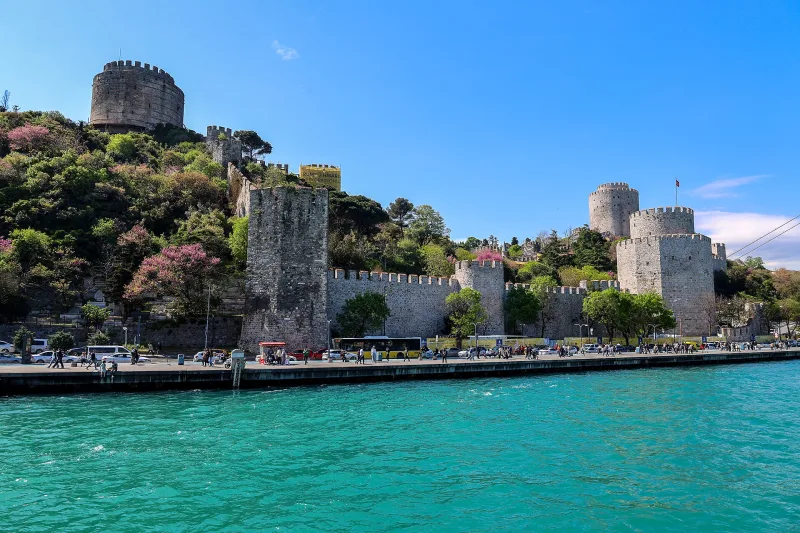
Rumeli Hisarı (Turkish: Rumeli Hisarı) is a medieval Ottoman fortress on the European shore of the Bosphorus, built in the spring of 1452 by order of Sultan Mehmed II just a few months before the fall of Constantinople. Its alternative name, Boğazkesen—“cutter of the strait” or, literally, “cutter of the throat”—accurately describes both the strategic purpose and the nature of this place. Together with the older Anadolu Hisar fortress on the opposite Asian shore, Rumeli Hisar blocked the narrowest point of the strait and cut Byzantium off from aid coming from the Black Sea. Today it is an open-air museum in the Sarıyer district, featuring three massive towers, crenellated walls, the minaret of an old mosque, and views of the Fatih Sultan Mehmet Bridge. A walk through Rumeli Hisar is a journey back to that spring of 1453, when the fate of an entire era was being decided.
History and Origins of Rumeli Hisar
The idea of blocking the Bosphorus originated with the Ottomans as early as the late 14th century, when they were just beginning to dream of Constantinople as their future capital. Mehmed II’s father, Sultan Murad II, had already encountered the Byzantine fleet blocking the strait and thwarting the siege during one of his previous campaigns. The young Mehmed, who ascended the throne in 1451, remembered this lesson and prepared differently.
The catalyst was a diplomatic provocation by Constantine XI: the Byzantine emperor hinted that he might release the Ottoman pretender Orhan and stir up internal unrest. Mehmed viewed this gesture as a pretext for war. He chose the narrowest part of the Bosphorus for the new fortress—about 660 meters according to British data and 698 meters according to Turkish data—directly opposite the existing Anadolu Hisar, which had been built by Sultan Bayezid I in 1393–1394. On the chosen hill, there had once stood a Roman fortification, later used by the Byzantines and Genoese as a prison, and even later as the Phoneus Monastery. It was assumed that the two fortresses, working in tandem, would block any aid to Constantinople from the Genoese colonies on the Black Sea—Caffa, Sinope, and Amasra.
Construction began on April 15, 1452. The timeline is astonishing: according to various sources, the fortress was built in 90 days or in four months and sixteen days. The Byzantine chronicler Doukas claimed that a thousand craftsmen worked on the construction; the Turkish architectural historian E. H. Aiverdi provided a more detailed estimate—about 300 craftsmen, 700–800 laborers, and 200 carters, boatmen, and transport workers. Stone was brought from Anatolia, and timber from Izmit and Eregli on the Black Sea. The three main towers were assigned to the viziers: Sarija Pasha built the northern one, Zaganos Pasha the southern one, and Khalil Pasha the coastal one near the gate. The sultan himself personally supervised the progress of the work. According to legend, when viewed from above, the fortress’s layout forms the Arabic script of the names Mehmed and Muhammad.
After the fall of Constantinople in 1453, Rumeli Hisar changed its function: first as a garrison and customs post, then as a prison for foreign captives, primarily ambassadors from hostile states. The Sarija Pasha Tower served as a torture chamber for a long time. The fortress was damaged by the Great Istanbul Earthquake of 1509, but it was quickly restored. In 1746, a fire destroyed the wooden roofs of two towers; Sultan Selim III oversaw a major renovation. By the 18th century, Rumeli Hisar had completely lost its military significance, and by 1876–1877, there were already 46 residential buildings within the walls and along the perimeter. It was not until 1953, by decree of President Celal Bayar, that the residents were relocated, and from May 16, 1955, to May 29, 1958, a large-scale restoration took place. Since 1960, Rumeli Hisar has operated as a museum.
Architecture and What to See
The fortress covers approximately 31,250 square meters (according to Turkish data—about 32,000 square meters), stretches 250 meters from north to south, and is 50 to 125 meters wide. Its silhouette is formed by three main towers, one small tower, and thirteen watchtowers on the connecting walls. One watchtower is a tetrahedron, six are polyhedrons, and another six are cylinders. There are three main gates, as well as side and secret passages leading to the arsenal and supply depots near the southern tower.
The three main towers: Sarija, Halil, and Zaganos
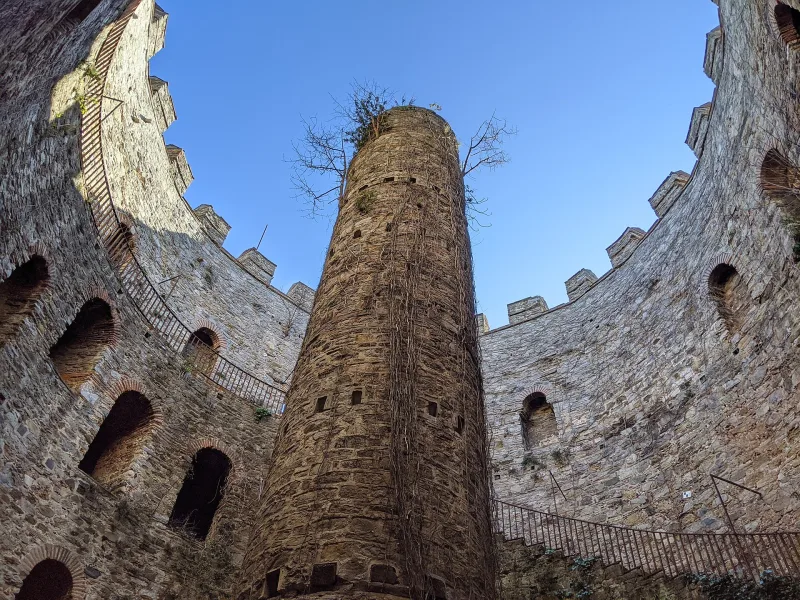
The northern tower, Saryja Pasha, is often called the Fatih (Conqueror) Tower in honor of Mehmed II. It is a cylinder with a diameter of 23.30 meters, walls seven meters thick, and a height of 28 meters; inside, there are nine levels. The coastal tower of Halil Pasha is a dodecagonal prism of the same diameter, but with thinner walls (6.5 meters) and a height of 22 meters, also comprising nine stories. The Southern Tower of Zaganos Pasha is a cylinder with a diameter of 26.70 meters, a height of 21 meters, walls 5.7 meters thick, and eight levels. Wooden floors inside the towers once divided them into residential and storage levels, each with its own hearth; the roofs were conical and covered with lead, but they have not survived to the present day.
Walls, Gates, and Minaret
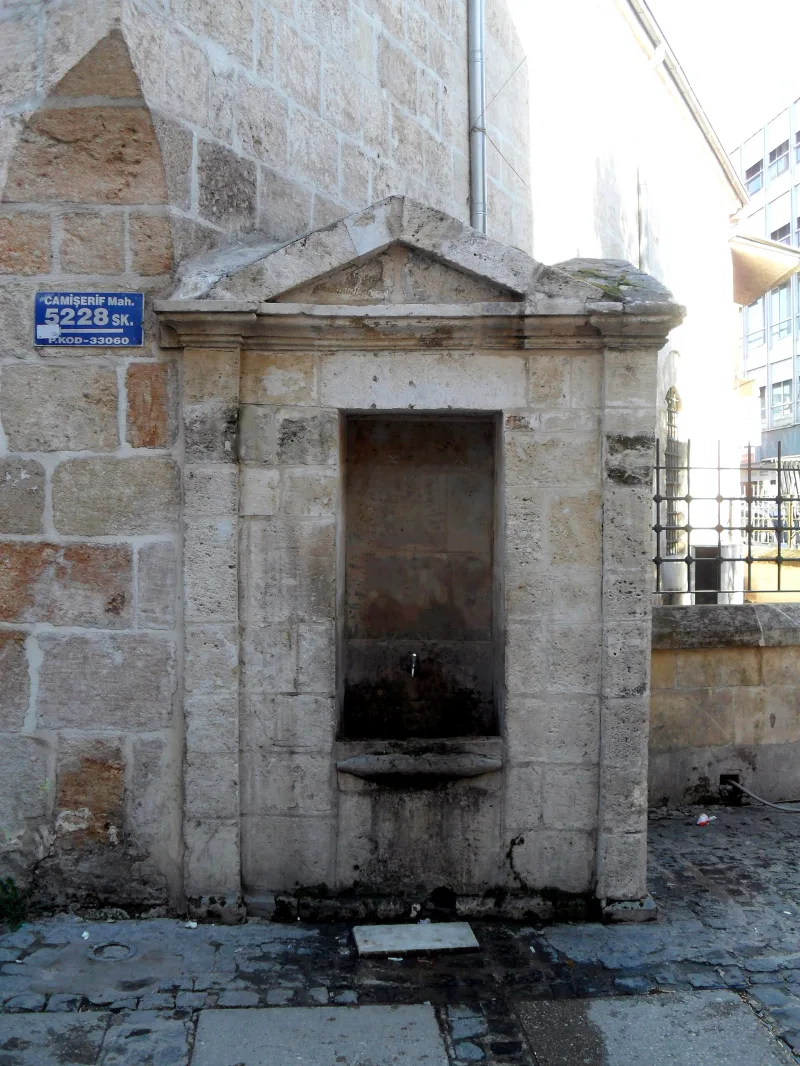
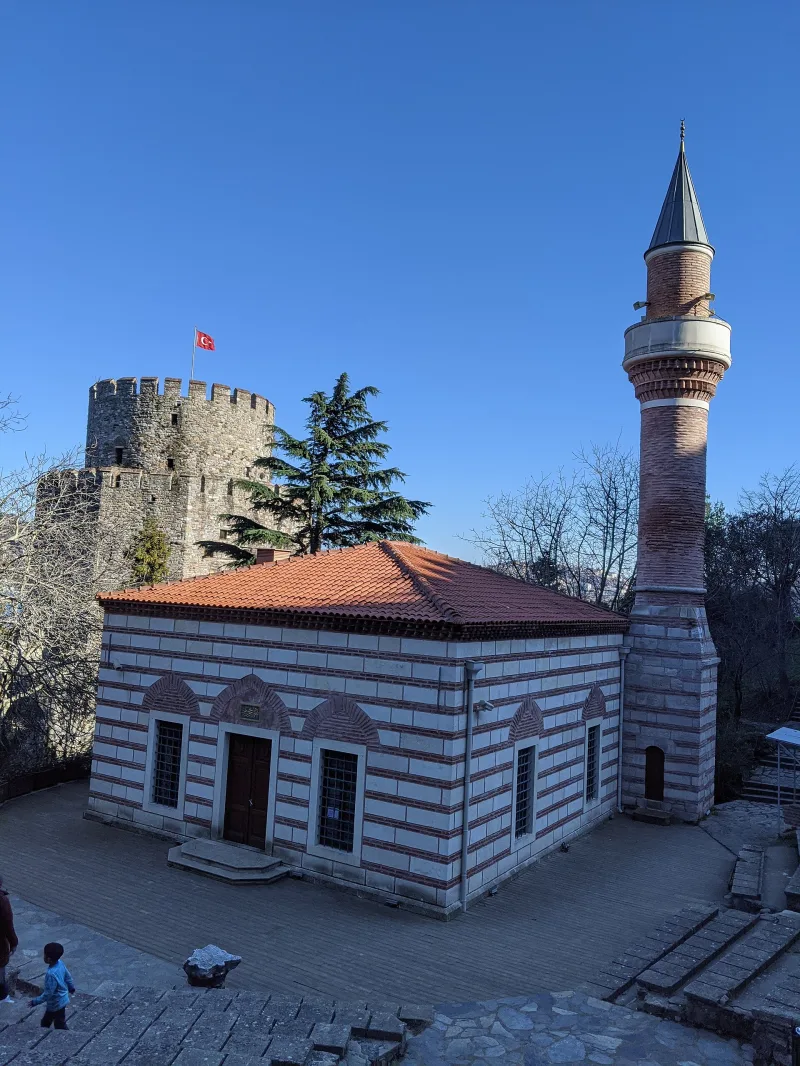
The curtain walls connect the towers in a smooth arc down the hillside. Traces of massive bolts are still visible at the three large gates. The inner courtyard once housed the wooden homes of the Janissaries and a small mosque gifted by the sultan. Of this first mosque, the Boğazkesen Mescidi, only the lower tier of the minaret has survived—a characteristic Ottoman brick cylinder without a top. The small mosque, added in the mid-16th century, has not survived, and the new Boğazkesen Fetih Mosque, built on the site of the old one, was completed in 2015 according to a design by the Istanbul Municipality. Water was supplied to the fortress from a large cistern beneath the mosque, and from there to three wall fountains, of which only one has survived. Two commemorative inscriptions detailing the construction remain on the walls.
Amphitheater and Artillery Exhibition
In the 1950s, an open-air summer theater was built on the site of the old mosque: initially, it consisted of simple viewing terraces with a stage; later, at the request of director Muhsin Ertuğrul, it was converted into an amphitheater. From 1989 to 2008, the famous “Rumeli Hisarı Concerts”—one of Istanbul’s major summer festivals—were held here; the concerts finally came to an end in 2008. Today, visitors can explore an open-air exhibition of Ottoman artillery: massive cannon barrels, pyramids of cannonballs, and a fragment of the chain with which, according to legend, the Byzantines blocked the entrance to the Golden Horn. The Halil Pasha Tower by the water once housed a garrison of 400 Janissaries and the largest cannons—it was from here that they fired upon passing ships. Inside the Zaganos Pasha Tower, you can climb the restored staircases to the upper levels and find yourself at the same height as the roofs of the neighboring yalıs. Since 2022, the Istanbul Municipality has been conducting a new round of restoration work in the fortress, so some areas are occasionally closed—it’s worth checking the schedule before your visit.
Interesting Facts and Legends
- When Rumeli Hisar was first built, it was known simply as Boğazkesen—"the strait-cutter." In Turkish, the word boğaz means both "strait" and "throat," so the name immediately carried a grim double meaning: the fortress cut off both the sea route and the very lives of foreign ships.
- One of the first clashes at the fortress walls served as a terrible lesson for European sailors. A Venetian ship that ignored the signal to stop was sunk by a single volley from the Halil Pasha tower. The surviving sailors were beheaded, and the captain was impaled and displayed on the shore as a “living scarecrow” for other merchants.
- According to legend, the fortress’s layout spells out the names “Mehmed” and “Muhammad” in Arabic script: the sultan wanted the very design of the walls to be an homage to his heavenly patron.
- An image of the fortress also appeared on Turkish banknotes—it was minted on currency from 1939 to 1986, placing it among the republic’s main symbols.
- When the fortress’s strategic role faded following the construction of a second pair of forts further up the Bosphorus, at the entrance to the Black Sea, Halil Pasha’s cannons continued to fire salutes for a long time—welcoming the sultan as he passed through the strait. This tradition was maintained until the second half of the 19th century.
How to get there
Rumeli Hisar is located in the Sarıyer district on the European shore of the Bosphorus, about 12 kilometers north of Sultanahmet. The most atmospheric way to get there is by water: regular Şehir Hatları ferries from the Eminönü and Beşiktaş piers travel along the Bosphorus, and from the deck you can first see Dolmabahçe Palace, then the Ortaköy and Arnavutköy neighborhoods, and finally the fortress towers rise up on the starboard side. The nearest pier is Rumeli Hisarı İskelesi; from there, it’s a five-minute walk to the entrance.
By land: From Taksim Square and Kabataş, buses 22, 22RE, and 25E run directly along the waterfront and stop at the fortress (Rumeli Hisarı stop). From the Levent district, it’s convenient to take the M2 metro line to Hacıosman station, and then continue for 10–15 minutes by taxi or bus 59A. For tourists arriving at IST Airport, the easiest way is to take the M11 metro line with transfers to the M2 line, followed by a bus. There is limited parking near the walls, and it fills up quickly on weekends, so driving is not the best option.
Tips for travelers
The best time to visit is spring and fall, when there is no sweltering Istanbul heat and the light over the strait is particularly soft. In summer, plan your visit for early morning or closer to sunset: during the day, there is almost no shade on the open walls, and the marble slabs get very hot. Allow one and a half to two hours for your visit—this will be enough to walk around the courtyard, climb the accessible towers, and take your time photographing the panorama of the Fatih Sultan Mehmet Bridge.
You’ll need closed-toe shoes with non-slip soles: the staircases in the towers are steep, with steps of varying heights, and in some places the original 15th-century masonry has been preserved. The climb may be difficult for children under six or seven, but they’ll enjoy the cannons and cannonballs down by the amphitheater. Bring water with you—there are no kiosks inside, but just beyond the gates, along the Bebek–Rumeli Hisarı waterfront, there are dozens of seafood restaurants and cafes where you can catch your breath. Before your visit, check the current schedule on the website muze.gov.tr: starting in 2022, some areas are periodically closed for restoration.
It’s convenient to combine a tour of the fortress with other sights on the European shore: Dolmabahçe Palace, Ortaköy Mosque, bohemian Arnavutköy, and trendy Bebek—all of this fits into one packed day. If you want to see the fortress in its entirety, take a boat to the opposite shore and view Rumeli Hisar from the Anatolian side: this is the view most often featured on classic Istanbul postcards. And if you stay until sunset, find a spot on the waterfront opposite the Halil Pasha Tower and wait for the moment when the sun dips below the European shore: at that moment, the walls of Rumeli Hisar turn copper-colored, and the Bosphorus resembles a river of molten silver—it’s worth coming here just for that one shot.